
Acoustic Damping Mats Successfully Installed in Our Maritime Test Facility
 We are pleased to announce the successful completion of a key upgrade to our maritime measurement facility. The acoustic damping mats for our 5 m × 5 m × 5 m maritime measurement track — a specialized water basin designed for high-precision testing — have now been fully installed.
The installation process required careful planning and execution. To ensure optimal placement and adhesion, the damping materials were initially mounted on the basin floor and walls while the tank was empty. This allowed our team to work with maximum accuracy and efficiency during the primary installation phase.
A particularly demanding stage followed once the basin was partially filled. The final two meters of damping mats were installed under water, requiring specialized procedures and techniques. In some areas, the work could only be completed through diving operations, highlighting both the technical complexity of the project and the dedication of our team.
Following the installation, we conducted validation measurements at an approximate center frequency of 50 kHz. The results clearly demonstrate the effectiveness of the upgrade: the reverberation time within the basin has been reduced by approximately a factor of eight. This substantial improvement significantly enhances the acoustic environment and confirms the performance of the damping system.
By minimizing unwanted sound reflections and improving noise control, the damping mats create a more stable and controlled testing environment. This directly contributes to greater measurement reliability, improved data quality, and expanded experimental capabilities.
With this enhancement, our maritime measurement track is now better equipped to support advanced research, development, and validation activities.
We would like to thank everyone involved in the planning and execution of this challenging project. Their expertise and commitment made this successful implementation possible.
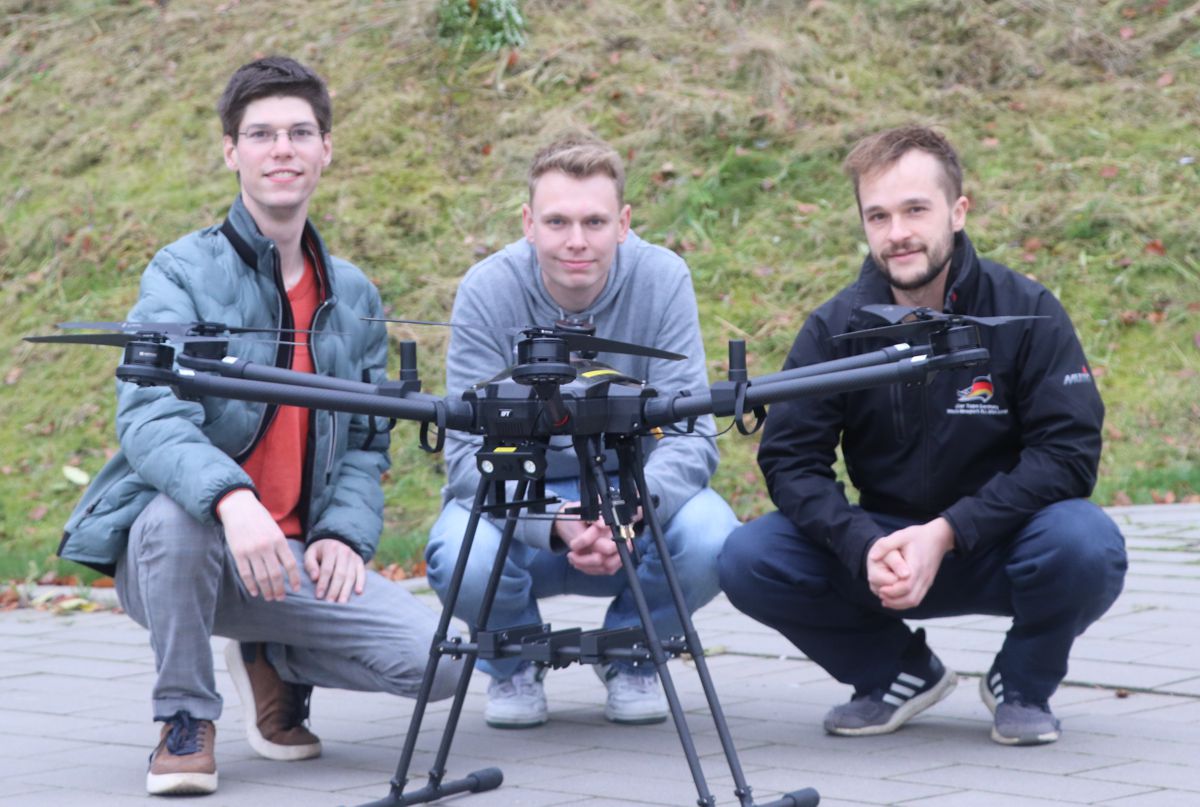 Since early summer, Julius Braun-Dullaeus, David Thesing and Martin Semmelrodt have joined the DSS team, bringing expertise in embedded systems, sensor hardware and physics. Julius has been connected to DSS throughout his studies, working on stochastic modeling and underwater signal processing. His current work focuses on a drone-based system for localizing and classifying magnetic objects. David continues his master’s research at DSS, combining thin-film sensor development with real-time signal processing for 3D SONAR beamforming. Martin joined in August after completing his master’s degree in theoretical physics. Having first encountered DSS through a collaboration at Müller-BBM, he now works on drone-based magnetic detection of underwater objects and will take over the project from Julius in January.