
Lab "Embedded Signal Processing"
| Basic Information | |
|---|---|
| Lecturers: | Finn Röhrdanz |
| Room: | KS2/Geb.G - PC-Labor |
| Language: | German |
| Target group: | Students in electrical engineering and information technology as well as students in electrical engineering, information technology and business management |
| Prerequisites: | Signals and systems I,II |
| Registration procedure: |
If you want to sign up for this laboratory, you need to register with the following information in the registration form
Please note, that the registration period starts the 01.03.2026 at 08:00 am and ends the 07.04.2026 at 11:59 pm. All applications before and after this registration period will not be taken into account. Registration will be possible within the before mentioned time by sending an e-mail with your name and matriculation number to The registration is binding. A deregistration is possible by sending an e-mail with your name and matriculation number to Requirements, rules and commitments will be announced at the first experiment (attendance is mandatory). |
| Time: |
The first experiment takes place on the 17.04.2026 in KS2/Geb.G - PC-Labor. The corresponding documents will be distributed via E-mail. On Friday: 12:30- 16:00h |
| Contents: |
The presented lab "Embedded Signal Processing" is intended to prepare students for practical work in digital signal processing. Typical signal processing algorithms will be implemented during the lab on a signal processing platform using the C/C++ programming language. In addition, the lab deepens the theoretical knowledge of the two signal and systems lectures. The contents of the lab is the following:
|
| Evaluation | |||
|---|---|---|---|
 |
Current evaluation | |
Completed evaluations |
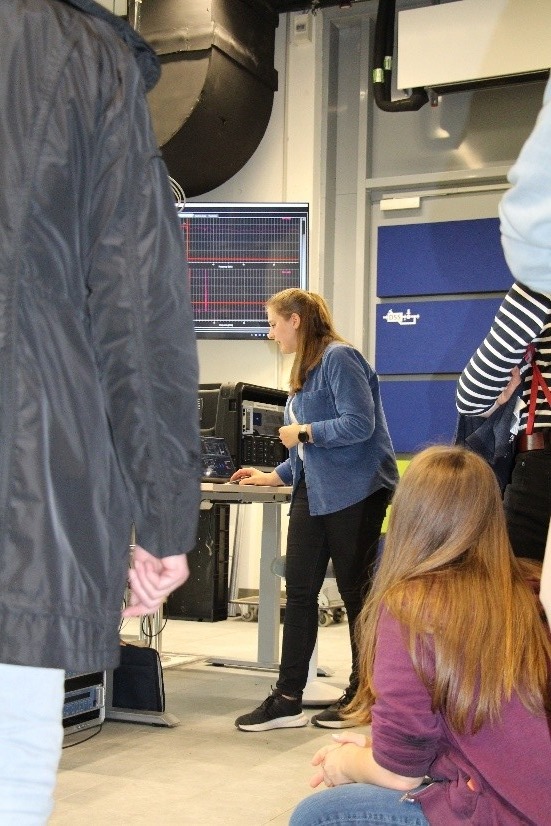 Science Day took place in Kiel and at the Faculty of Engineering on 25 September 2026. The DSS group contributed two demonstrations that gave visitors an insight into current research on signal processing, underwater acoustics and speech signals.