
Lecture "Design Space Exploration for Unmanned Systems"
| Basic Information | |
|---|---|
| Lecturers: | Frank Ehlers (lecture and exercise) |
| Room: | Unknown yet (see Univis for details) |
| E-mail: | |
| Language: | English |
| Term: | Winter term |
| Target group: | Students in electrical engineering and computer engineering |
| Prerequisites: | Interest in statistical signal processing and robotics |
| Contents: |
Students attending this lecture learn how to apply a model-based approach to find and describe the origins of uncertainty when designing unmanned systems. Major elements of the model-based approach are the interfaces between system modules dealing with uncertainty in measurements, decision making, planning, and control. Associated to these interfaces is a mathematical framework which the students learn to detail for given real-world applications. Topic overview:
|
| References: |
|
Registration for the Lecture
To get the lecture material, please send an e-mail to Dr. Frank Ehlers with your name, matriculation number, and e-mail address over which you will get the lecture material.
News
None
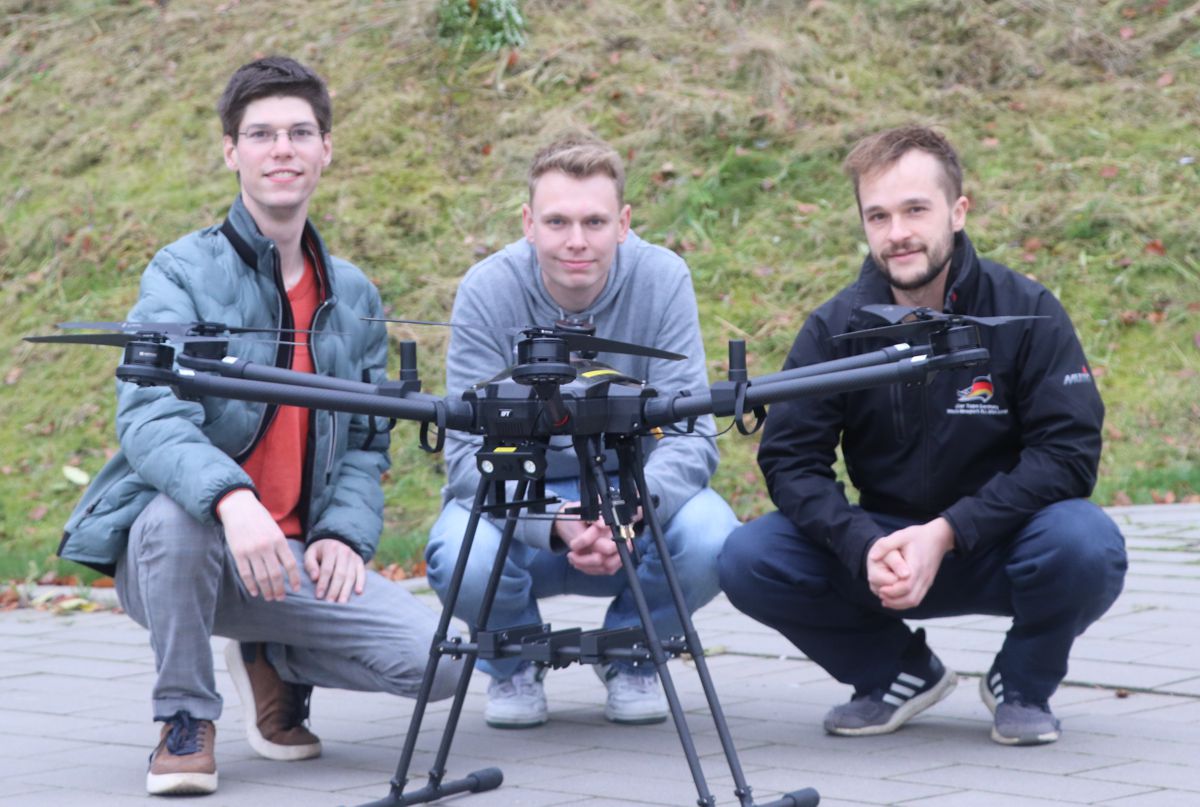 Since early summer, Julius Braun-Dullaeus, David Thesing and Martin Semmelrodt have joined the DSS team, bringing expertise in embedded systems, sensor hardware and physics. Julius has been connected to DSS throughout his studies, working on stochastic modeling and underwater signal processing. His current work focuses on a drone-based system for localizing and classifying magnetic objects. David continues his master’s research at DSS, combining thin-film sensor development with real-time signal processing for 3D SONAR beamforming. Martin joined in August after completing his master’s degree in theoretical physics. Having first encountered DSS through a collaboration at Müller-BBM, he now works on drone-based magnetic detection of underwater objects and will take over the project from Julius in January.