
Bitrate Detection for the AMR-WB Codec
The following speech samples are provided to illustrate speech coding effects of the AMR-WB codec at different bitrates. For the single coded examples, the original speech signal was simply coded and decoded at the specified bitrate. For the tandem coded examples, the single coded signals were subject to a consecutive stage of coding and decoding.
Examples - Single coded
| Bitrate | Male | Female | ||
| Original |
|
|
||
| 6.60 kbit/s |
|
|
||
| 12.65 kbit/s |
|
|
||
| 23.85 kbit/s |
|
|
Examples - Tandem coded
| Bitrate | Male | Female | ||
| Original |
|
|
||
| 6.60 kbit/s, 6.60 kbit/s |
|
|
||
| 6.60 kbit/s, 12.65 kbit/s |
|
|
||
| 12.65 kbit/s, 12.65 kbit/s |
|
|
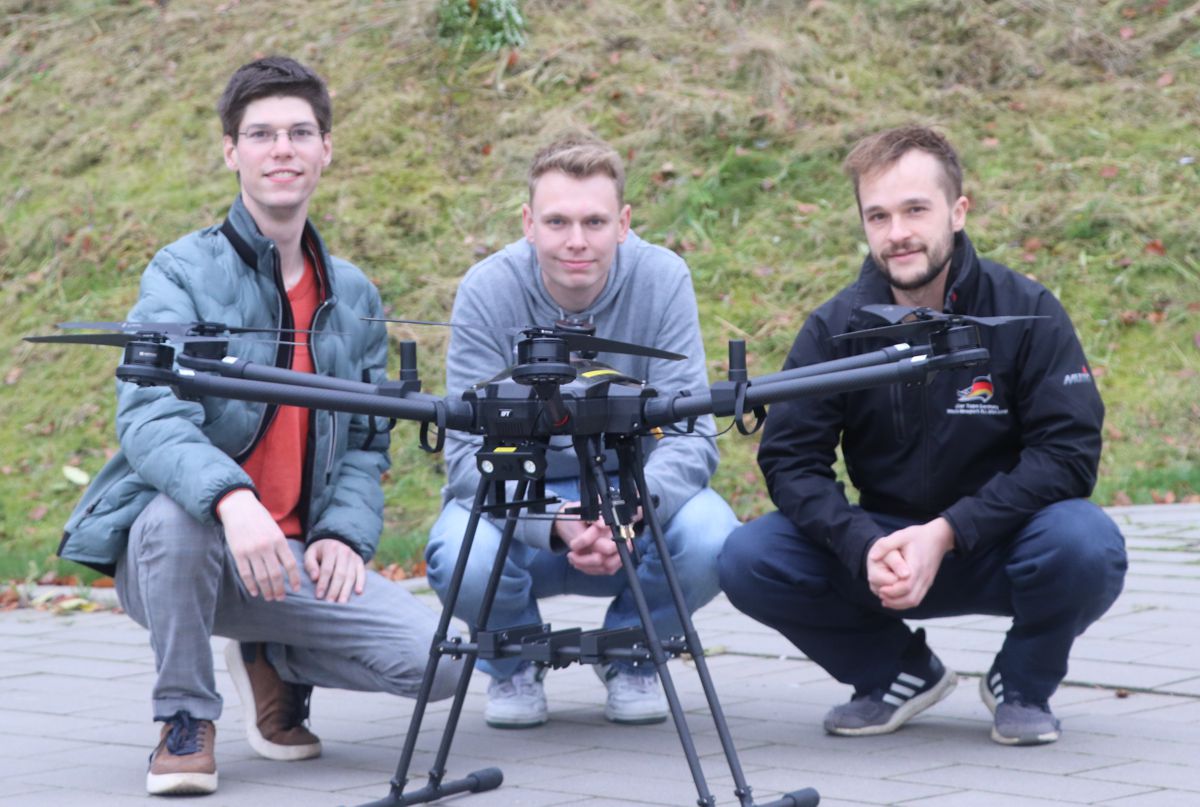 Since early summer, Julius Braun-Dullaeus, David Thesing and Martin Semmelrodt have joined the DSS team, bringing expertise in embedded systems, sensor hardware and physics. Julius has been connected to DSS throughout his studies, working on stochastic modeling and underwater signal processing. His current work focuses on a drone-based system for localizing and classifying magnetic objects. David continues his master’s research at DSS, combining thin-film sensor development with real-time signal processing for 3D SONAR beamforming. Martin joined in August after completing his master’s degree in theoretical physics. Having first encountered DSS through a collaboration at Müller-BBM, he now works on drone-based magnetic detection of underwater objects and will take over the project from Julius in January.