Prediction-based Filter Design
The section is currently in progress ...

The section is currently in progress ...
RED (robust and efficient DSP) is a collection of algorithms that should help engineers to implement basic signal processign tasks in - as the name states - a robust and efficient way. This includes mainly numerical aspects.
Here you can find the chapter on prediction-based filter design as a single pdf file. If you would like to download all chapters please go to the RED overview page and get the pdf document that contain all chapters from there.
 |
Pdf file of this section |
 |
Matlab script for a signal generator with an arbitrarily specified power spectral density |
|
Matlab script on yyy |
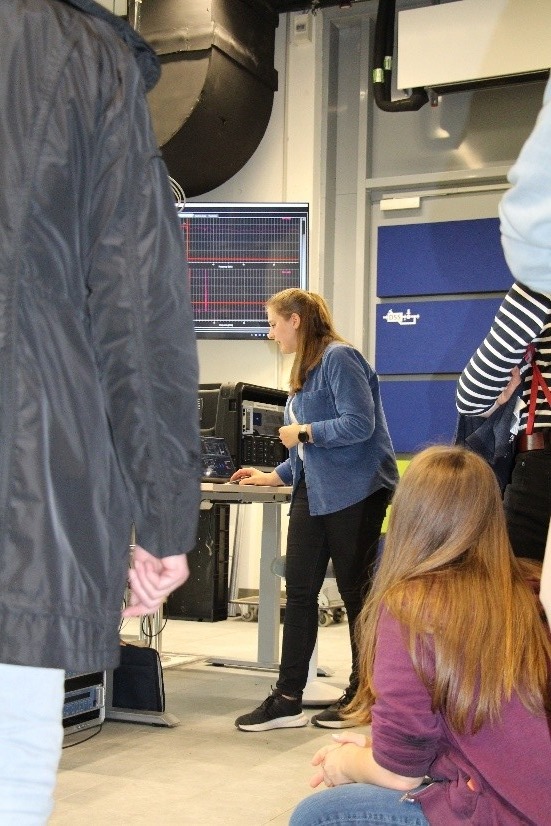 Science Day took place in Kiel and at the Faculty of Engineering on 25 September 2026. The DSS group contributed two demonstrations that gave visitors an insight into current research on signal processing, underwater acoustics and speech signals.
The first demonstration, presented by Karo G. and Viktoriia, focused on the “Digital Ocean” and research using underwater sound. At the maritime test facility, visitors explored how signals are transmitted underwater and used in SONAR systems.
The second demonstration explored the human voice and how people can practise controlling their vocal volume. At a hands-on station, Karo H. showed how audio feedback can support voice-volume training.