
 |
M. Sc. David ThesingRoom: C-01.021 (ZEVS)Kaiserstraße 2, 24143 Kiel, Germany Phone: +49 431 880-6132 E-mail: ORCID:  0009-0001-9578-4965 |
|---|
Research: Array Design with thin-film sensors for SONAR systems
The design of arrays for SONAR systems is constrained by the size of conventional hydrophones. Complex geometries, in particular, make the design of sensor arrays more difficult. Piezoelectric thin-film sensors are an attractive alternative to conventional hydrophones, as they are smaller and therefore offer expanded possibilities for the development and construction of arrays. The aim is to design a SONAR system including a cylindrical sensor array out of the piezoelectric thin-film sensors. The newly developed and constructed array enables 3D beamforming, which is to be implemented afterwards.
Related topics:
- Real-time signal processing
- SONAR Systems
- Array Design
Further interests:
- Machine Learning
- Hardware Design
- Prototyping
Short CV
| Time span | Details |
|---|---|
| 2026 - current | Research assistant at the Christian-Albrechts-Universität zu Kiel, Kiel, Germany |
| 2024 - 2026 | M.Sc. in Electrical Engineering and Information Engineering at the Christian-Albrechts-Universität zu Kiel, Kiel, Germany |
| 2021 – 2024 | B.Eng. in Electrical Engineering at Duale Hochschule Baden-Württemberg, Mannheim, Germany |
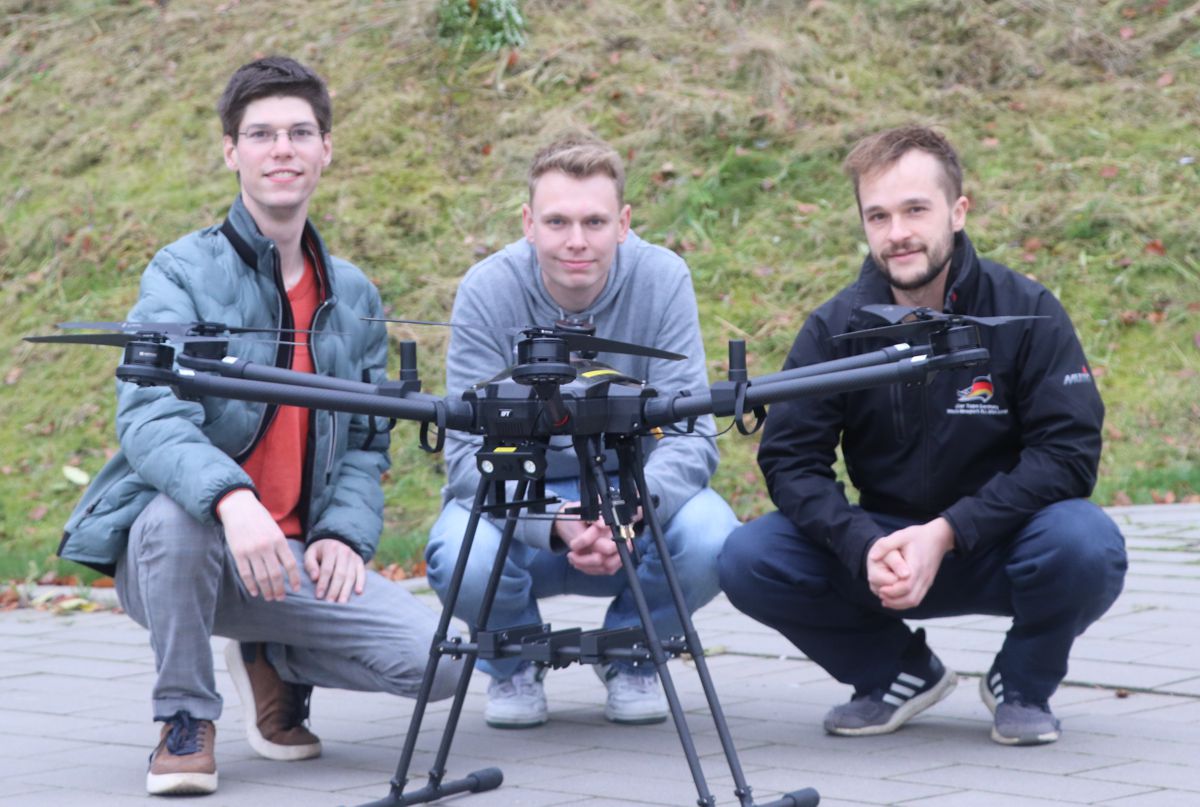 Since early summer, Julius Braun-Dullaeus, David Thesing and Martin Semmelrodt have joined the DSS team, bringing expertise in embedded systems, sensor hardware and physics. Julius has been connected to DSS throughout his studies, working on stochastic modeling and underwater signal processing. His current work focuses on a drone-based system for localizing and classifying magnetic objects. David continues his master’s research at DSS, combining thin-film sensor development with real-time signal processing for 3D SONAR beamforming. Martin joined in August after completing his master’s degree in theoretical physics. Having first encountered DSS through a collaboration at Müller-BBM, he now works on drone-based magnetic detection of underwater objects and will take over the project from Julius in January.