
Lecture "Pattern Recognition and Machine Learning"
| Basic Information | |
|---|---|
| Lecturers: | Gerhard Schmidt (lecture) and Sören Lange / Julius Braun-Dullaeus (exercise) |
| Room: | KS2/Geb.F - SR-II |
| E-mail: | |
| Language: | English |
| Target group: | Students in electrical engineering and computer engineering |
| Prerequisites: | Basics in system theory |
| Contents: |
In this lecture the basics of speech, audio, and music signal processing are treated. Often schemes that are based on statistical optimization are utilized for these applications. The involved cost function are matched to the human audio perception. Topic overview:
|
News
No news yet.
Schedule
The following schedule regarding lectures and excercises is preliminary and may be adapted during the semester. The lecture will usually take place from 14:30 h - 17:00 h. The exercise will follow after at 17:15 h - 18:00 h.
| Date | Lecture | Exercise |
|---|---|---|
| 20.10.2026 | Introduction | - |
| 27.10.2026 | Noise Suppression and Cost Functions | Noise Suppression (video and exercise in the lecture room) |
| 03.11.2026 | Beamforming | Beamforming (video and exercise in the lecture room) |
| 10.11.2026 | Feature Extraction | Feature Extraction (video and exercise in the lecture room) |
| 17.11.2026 | Codebook Training | Codebook Training (video and exercise in the lecture room) |
| 24.11.2026 | Bandwidth Extension | Bandwidth Extension (video and exercise in the lecture room) |
| 01.12.2026 | Object-to-vector Conversion | Object-to-vector Conversion (exercise in the lecture room) |
| 08.12.2026 | Gaussian Mixture Models (and Speaker Recognition) | Gaussian Mixture Models (video and exercise in the lecture room) |
| 15.12.2026 | Neural Networks - Part 1 | - |
| 05.01.2027 | Neural Networks - Part 2 | Neural Networks (video and exercise in the lecture room) |
| 12.01.2027 | Student talks | - |
| 19.01.2027 | Hidden Markov Models | Hidden Markov Models (video and exercise in the lecture room) |
| 26.01.2027 | Explainable artificial intelligence | Explainable artificial intelligence (exercise in the lecture room) |
| 02.02.2027 | TBD | TBD |
Lecture Slides
| Link | Content |
|---|---|
 |
Slides of the lecture "Introduction" (Introduction, boundary conditions of the lecture, applications) |
|
Slides of the lecture "Noise Suppression" (Noise suppression, dereverberation, speech reconstruction) |
|
Slides of the lecture "Beamforming" (Fixed and adaptive beamforming, postfiltering) |
|
Slides of the lecture "Feature Extraction" (Linear prediction, cepstrum, mel-filtered cepstral coefficients) |
|
Slides of the lecture "Codebook Training" (K-means algorithm, LBG algorithms) |
|
Slides of the lecture "Bandwidth Extension" (Model-bases approaches, evaluation) |
|
Slides of the lecture "Object-to-vector Conversion (word to vector conversion)" (Word2Vec) |
|
Slides of the lecture "Gaussian Mixture Models (GMMs)" (Training with the EM algorithm, applications) |
|
Slides of the lecture "Neural networks" (Network types, training procecures) |
|
Slides of the lecture "Hidden Markov Models (HMMs)" (Efficient probability calculation, training of HMMs) |
|
Slides of the lecture "Explainable artificial intelligence" (Understanding what had contributed mainly to the decision of neural networks, etc.) |
Matlab Demos
| Link | Content |
|---|---|
 |
Matlab demo (GUI based) for adaptive noise suppression |
|
Matlab demo (GUI based) for linear prediction |
Exercises
For each lecture topic on-demand video will be provided. There will be an in-presence exercises to discuss your questions and requested topics. You may send in questions (if you want the answer to be supported by slides) or exercise topic suggestions to
| Video | Content | Material |
|---|---|---|
|
Noise suppression:
|
|
|
|
Beamforming:
|
||
|
Feature extraction:
|
||
|
Codebook training:
|
||
|
Bandwidth extension:
|
||
|
Object-to-Vector Conversion:
|
||
|
Gaussian Mixture Models:
|
||
|
Neural Networks:
|
||
|
Hidden Markov Models:
|
||
|
Speaker and Speech Recognition:
|
||
|
Explainable AI:
|
Talks
Each student will give a talk about a certain topic. The aim is both to give you the chance to work on a pattern recognition-related topic that interests you, and to improve your presentational skills. The talk is also a prerequisite for your admission to the exam. The talks should be held in English and should take 10 minutes, plus 2.5 minutes of discussion and 2.5 minutes of feedback. Please write an email to
Handouts after a presentation are a valuable addition because they help the audience retain and review the key information. During a talk, listeners may miss important details or forget specific points. A well-prepared handout summarizes the main ideas, highlights essential data, and provides useful references for further reading. These references can be especially helpful if listeners want to explore the topic in more depth and continue learning on their own. It also allows participants to focus more on listening instead of taking extensive notes. Overall, handouts support understanding, reinforce learning, and make the presentation more effective and memorable.
For the reasons mentioned above, we have prepared a template for a handout. You can find that here. Please fill (and change) it with your presentation details and send it to us (same e-mail adress as mention above) prior to your talk.
Evaluation
The completed evaluations of the last years can be found here. Please note that this page contains the evaluations of all of our lectures. As a consequence you must scroll down to get to the evaluations of this lecture.
Exams
Remember to register for the exam in the QiS system! And book a time-slot for your oral exam using this form.
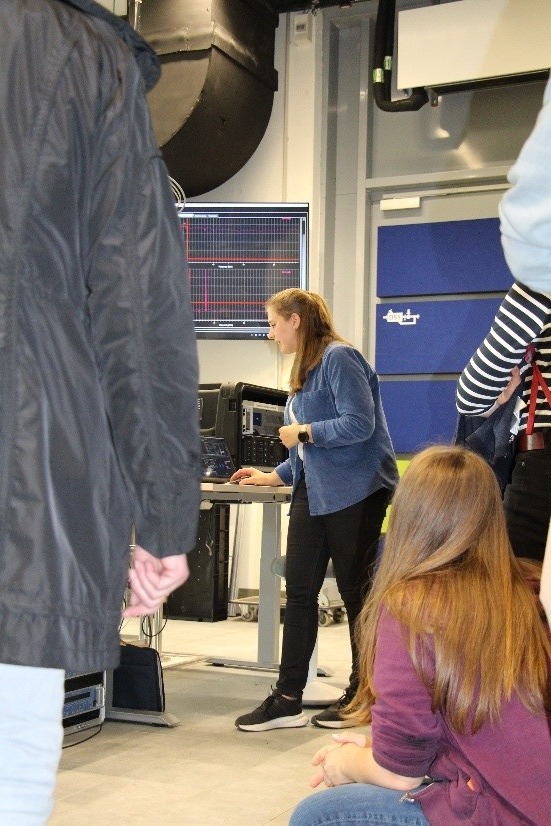 Science Day took place in Kiel and at the Faculty of Engineering on 25 September 2026. The DSS group contributed two demonstrations that gave visitors an insight into current research on signal processing, underwater acoustics and speech signals.