
Lecture "Adaptive Filters"
| Basic Information | |
|---|---|
| Lecturers: | Gerhard Schmidt (lecture), Viktoriia Boichenko and Lukas Schirmer (exercise) |
| Room: | Building F, room SR-IV |
| E-mail: | |
| Language: | English |
| Target group: | Students in electrical engineering and computer engineering |
| Prerequisites: | Basics in system theory |
| Contents: |
Students attending this lecture should learn the basics of adaptive filters. To achieve this, necessary algorithms will be derived and applied to problems arising in speech and audio processing. The algorithms comprise Wiener filtering, linear prediction, and adaptive schemes such as the NLMS algorithm, affine projection, and the RLS algorithm. For applications from speech and audio processing, we use noise and reverberation reduction, echo cancellation, and beamforming. Topic overview:
|
News
If you’re reading this, the signal-to-news ratio is currently zero.
Schedule
The following schedule regarding lectures and exercises is preliminary and may be adapted during the semester.
Each event starts at 8:15 h and might use the whole slot (lecture and exercise) until 11:45 h.
| Date | Event |
|---|---|
| 17.04.2026 | Lecture: Introduction |
| 08.05.2026 | Lecture: Wiener filter |
| 15.05.2026 | Lecture: Linear prediction |
| 22.05.2026 | Exercise: Wiener Filter and linear prediction |
| 29.05.2026 | Lecture: Algorithms part I |
| 05.06.2026 | Lecture: Algorithms part II |
| 12.06.2026 | Lecture: Control |
| 19.06.2026 | Exercise: Algorithms and Control |
| 26.06.2026 | Lecture: Processing structures |
| 03.07.2026 | Exercise: Processing structures + (at 10:15 am)Lecture: Applications of linear prediction |
| 10.07.2026 | Student talks (Part I) |
| 10.07.2026 | Student talks (Part II) at 14:00 o'clock |
Lecture Slides
| Link | Content |
|---|---|
 |
Slides of the lecture "Introduction" (Introduction, boundary conditions of the lecture, applications) |
|
Slides of the lecture "Wiener Filter" (basics, principle of orthogonality, suppression of background noise) |
|
Slides of the lecture "Linear Prediction" (derivation of linear prediction, Levinson-Durbin recursion) |
|
Slides of the lecture "Algorithms (Part 1 of 2)" (RLS algorithm, LMS algorithm [part 1 of 2]) |
|
Slides of the lecture "Algorithms (Part 2 of 2)" (LMS algorithm [part 2 of 2], affine projection algorithm) |
|
Slides of the lecture "Control" (basic aspect, pseudo-optimal control parameters) |
|
Slides of the lecture "Processing Structures" (polyphase filterbanks, prototype lowpass filter design) |
|
Slides of the lecture "Applications of Linear Prediction" (Improving the speed of convergence, filter design) |
Extensions
| Link | Content |
|---|---|
|
Extension for the lecture "Wiener Filter" (derivation of the error surface) |
Matlab Demos
| Link | Content |
|---|---|
 |
Matlab demo (GUI-based) for adaptive system identification |
|
Matlab demo (GUI-based) for adaptive noise suppression |
|
Matlab demo (GUI-based) for linear prediction |
|
Matlab demo (GUI-based) for the NLMS algorithms |
|
Matlab demo (GUI-based) for prediction-based filter design |
Exercises
We provide additional videos and corresponding materials (e.g., questions and answers) for each topic below.
Exercises will be conducted according to the (preliminary) schedule above. Please register for the corresponding OLAT course to receive further information by mail (https://lms.uni-kiel.de/url/BusinessGroup/3276832778). Please bring a notebook for the exercises.
| Video | Content | Material |
|---|---|---|
|
Wiener filter:
|
|
|
|
Linear prediction:
|
|
|
|
Algorithms:
|
|
|
|
Control:
|
|
|
|
Processing structures:
|
|
Student Talks
As part of the lecture, each student will give a talk about a certain topic as a prerequisite to sitting the exam. The aim is both to give you the chance to work on an adaptive filter-related topic that interests you and to improve your presentational skills. The talks should take ten minutes, plus 2.5 minutes of discussion and 2.5 minutes of feedback.
Please contact us via
Handouts after a presentation are a valuable addition because they help the audience retain and review the key information. During a talk, listeners may miss important details or forget specific points. A well-prepared handout summarizes the main ideas, highlights essential data, and provides useful references for further reading. These references can be especially helpful if listeners want to explore the topic in more depth and continue learning on their own. It also allows participants to focus more on listening instead of taking extensive notes. Overall, handouts support understanding, reinforce learning, and make the presentation more effective and memorable.
For the reasons mentioned above, we have prepared a template for a handout. You can find that here. Please fill (and change) it with your presentation details and send it to us (same email address as mentioned above) before your talk.
| Time | Topic | Presenter(s) |
|---|---|---|
| 08:15 h | Opening | Gerhard Schmidt |
| 08:20 h | Convex Combination of Adaptive Filters | Lars Marek |
| 08:35 h | Active noise control (anti-noise) | Bora Leckzik |
| 08:55 h | Digital implementation of the Moog ladder filter | Florian Haase |
| 09:05 h | Break | |
| 09:15 h | Wiener Filters for EEG Signals | Mert Evci |
| 09:30 h | Adaptive Filters for System Identification | Yogesh Kumar |
| 09:45 h | Hearing aids | Hebun Celikten |
| 10:00 h | Break | |
| 10:10 h | Adaptive Beamforming | Moritz Koch |
| 10:25 h | Adaptive Wave Filtering for Sailboat Autopilots | Andres Hoffmann |
| 10:40h | Acoustic Source Localization using a Uniform Circular Array (UCA) | Hasan Yesil |
| Further talks at the next event | ||
| 14:00 h | Adaptive Visual-Inertial Filtering for VR/AR Motion Tracking | Umut Gökçen |
| 14:15 h | Non-Linear Echo Cancellation Using Adaptive Filters | Emir Ozan Akdeniz |
| 14:30 h | Adaptive Equalization for Underwater Acoustic Channels | Keanu Kudicke |
| 14:45 h | Break | |
| 14:55 h | Noise Cancellation Using the LMS (Least Mean Squares) Algorithm with VLSI Implementation | Harshavardhan Nagraju |
| 15:10 h | Adaptive Filtering for Wearable Biomedical Sensors | Harshith Thorebailu Harish |
| 15:25 h | Extended Kalman Filter in SLAM | Evgeny Ratushnyak |
| 15:40 h | Break | |
| 15:50 h | Sparse Adaptive Filters | Jannis Kammeier |
Exams
If you do not have a date for the exam yet please register in the online booking system (once the exam dates have been set). You can find the booking system here.
Evaluations
The completed evaluations of the last years can be found here. Please note that this page contains the evaluations of all of our lectures. As a consequence, you must scroll down to get to the evaluations of this lecture.
The form for the current evaluation can be started here.
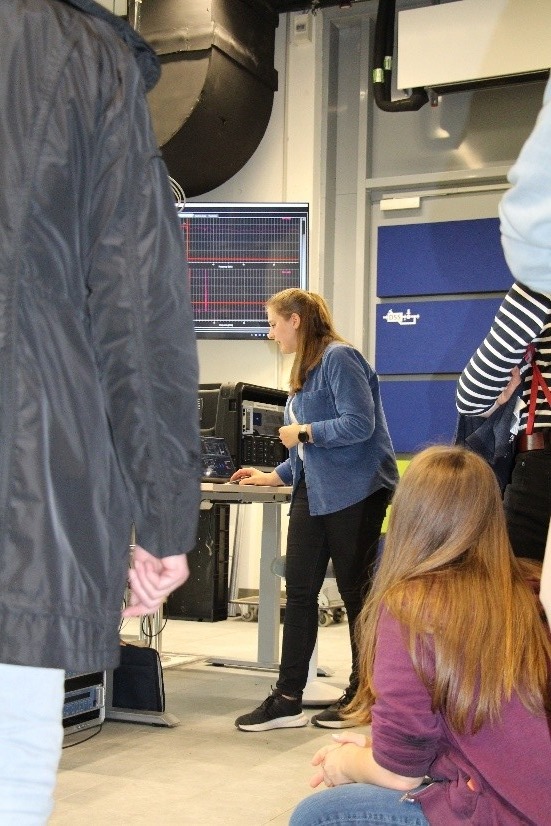 Science Day took place in Kiel and at the Faculty of Engineering on 25 September 2026. The DSS group contributed two demonstrations that gave visitors an insight into current research on signal processing, underwater acoustics and speech signals.